

Automotive Active Noise Cancellation Systems Market to Reach USD 3,097.59 Billion by 2035 at 8.15% CAGR
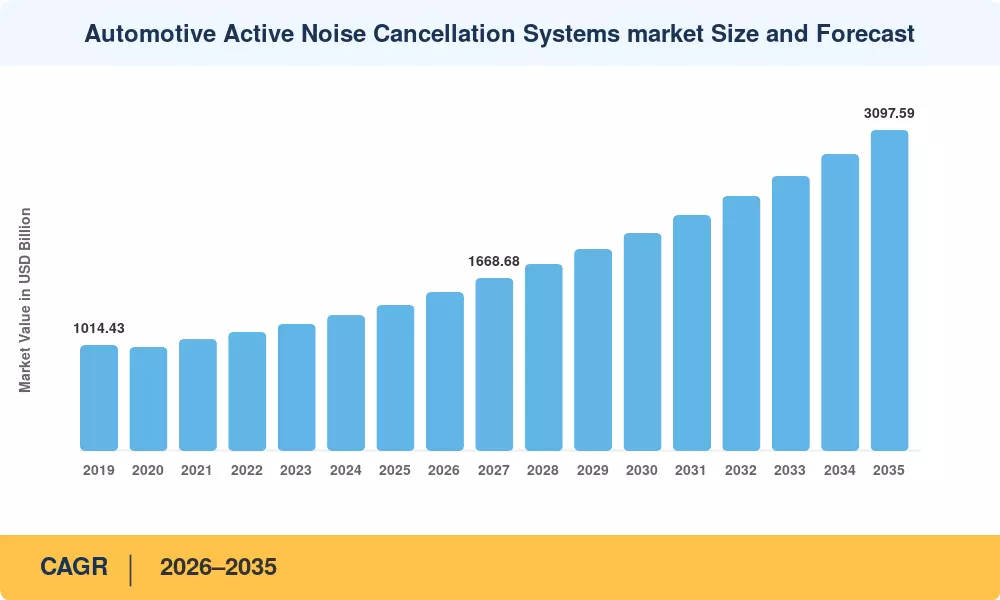
Automotive Active Noise Cancellation Systems Market
The global Automotive Active Noise Cancellation (ANC) Systems market was valued at USD 1,403.34 billion in 2025.
The global Automotive Active Noise Cancellation (ANC) Systems market was valued at USD 1,403.34 billion in 2025 and is projected to reach USD 3,097.59 billion by 2035.”
NEW YORK, NY, UNITED STATES, July 21, 2026 /EINPresswire.com/ -- The global Automotive Active Noise Cancellation (ANC) Systems market was valued at USD 1,403.34 billion in 2025 and is projected to reach USD 3,097.59 billion by 2035, registering a compound annual growth rate (CAGR) of 8.15% during the forecast period 2026–2035.— Arti Dhapte
Market Overview
Automotive Active Noise Cancellation (ANC) Systems represent a sophisticated electronic technology designed to reduce unwanted cabin noise in vehicles through the generation of anti-noise sound waves. These systems employ a combination of microphones, accelerometers, digital signal processors (DSPs), and speakers to detect, analyze, and cancel noise in real-time. The fundamental principle involves capturing reference noise signals (from engine, road, or wind sources), processing them through advanced algorithms to generate an inverted phase signal, and emitting this anti-noise through the vehicle's audio system to create destructive interference, effectively reducing the perceived noise level at occupants' ears. Modern ANC architectures range from feedforward and feedback systems to hybrid configurations and AI-enhanced adaptive solutions, integrated across various vehicle types and propulsion systems.
The market crossed the USD 1,529.84 billion threshold in 2026, the first year of the forecast window. Structural growth is underpinned by the accelerating global shift toward electric vehicles (EVs), which inherently lack internal-combustion-engine masking noise and therefore expose occupants to road and wind noise that must be actively managed. Concurrently, original equipment manufacturers (OEMs) pursuing aggressive lightweighting strategies are replacing heavy passive insulation materials—such as dense bitumen pads and mass-loaded vinyl barriers—with electronically driven ANC solutions that deliver superior noise attenuation at a fraction of the weight penalty. Consumer expectations for premium cabin acoustics have risen sharply, reinforced by the proliferation of in-car infotainment systems, voice-activated digital assistants, and hands-free communication features that demand a low-noise acoustic environment to function reliably.
Industry trends indicate a decisive shift toward software-defined, AI-adaptive, and connected noise management platforms. First-generation ANC systems used fixed-filter or slowly adaptive algorithms frozen during production. Second-generation systems (2025–2028) incorporate real-time adaptive DSP with wider frequency coverage and multi-zone cancellation. Third-generation systems (2029–2035) will provide personalized acoustic environments that dynamically adapt to individual occupant preferences, seating position, and road-surface conditions through centralized vehicle compute architectures and neural-network-based noise prediction. This evolution is supported by semiconductor platforms offering low-latency audio pipelines and processing headroom for real-time AI inference at the edge.
📍 Get Free Sample Report for Detailed Market Insights:
https://www.marketresearchfuture.com/sample_request/68389
Market Segmentation
By Technology Type
The market is segmented by technology type into Hybrid ANC, Feedforward ANC, Feedback ANC, and AI-Enhanced Adaptive ANC. Hybrid ANC holds the largest 2025 revenue share at approximately 46%, owing to its ability to address multiple noise sources simultaneously by combining feedforward paths that reference noise at source (e.g., road-surface vibration via accelerometers) with feedback paths that measure residual noise at the occupant's ear position. This dual architecture delivers 10–15 dB of cancellation across a 20–500 Hz bandwidth, outperforming single-path systems. Feedforward ANC represents the second-largest segment at roughly 30%, valued for cost-effective single-source noise cancellation (engine order cancellation). Feedback ANC accounts for about 15%, serving simpler installations and aftermarket applications. AI-Enhanced Adaptive ANC, while currently the smallest at approximately 9%, is the fastest-growing segment, driven by semiconductor platforms enabling real-time neural-network inference for noise prediction and filter optimization.
By Vehicle Type
Vehicle type segmentation includes Passenger Cars, Light Commercial Vehicles, and Heavy Commercial Vehicles. Passenger cars account for the largest 2025 share at approximately 72%, reflecting volume dominance from EV sedan and SUV adoption and consumer-driven demand for acoustic comfort. Light commercial vehicles represent the second-largest segment at about 18%, driven by last-mile delivery EV fleets requiring driver comfort. Heavy commercial vehicles, while the smallest segment at roughly 10%, represent the fastest-growing vehicle type, as occupational health regulations in Europe and North America increasingly mandate cabin-noise limits for long-haul truck drivers, creating a regulatory pull for ANC integration in Class 7–8 vehicles.
By Propulsion Type
Propulsion type segmentation covers ICE Vehicles, Electric Vehicles, and Hybrid Vehicles. ICE vehicles represent the largest 2025 installed base at approximately 52%, with engine-order cancellation remaining the primary use case. Electric vehicles are the fastest-growing propulsion segment at a CAGR of approximately 12.5%, driven by the structural need for road and wind noise cancellation in the absence of engine masking noise. Hybrid vehicles hold a moderate share of about 20%, with dual-mode noise profiles requiring versatile ANC algorithms. By 2030, EVs are expected to surpass ICE vehicles as the largest propulsion-type segment for new ANC installations.
By Application
Application segmentation includes Road Noise Cancellation (RNC), Engine Noise Cancellation (ENC), and Wind Noise Cancellation (WNC). Road noise cancellation holds the largest 2025 share at approximately 48%, driven by EV demand and tire-cavity resonance suppression. Engine noise cancellation represents the second-largest segment at about 32%, though its share is declining as EVs grow. Wind noise cancellation, while currently the smallest segment, is the fastest-growing at approximately 10.8% CAGR, as improved road-noise suppression makes wind noise the next most prominent source of cabin intrusion, particularly in streamlined EV body designs.
By Sales Channel
Sales channel segmentation includes OEM and Aftermarket. The OEM channel dominates with approximately 88% share, as effective ANC requires deep integration with the vehicle's sensor network, audio amplifiers, and electronic architecture. The aftermarket segment, while smaller, is the fastest-growing channel at approximately 12.2% CAGR, driven by retrofit demand for existing EV and hybrid fleets, as Bluetooth-connected and smartphone-processed ANC solutions lower the barrier to installation.
By Region
Regional segmentation includes North America, Europe, Asia Pacific, South America, and the Middle East and Africa. North America commands the largest share at approximately 35% of 2025 revenue. Asia-Pacific is the fastest-growing region with the highest CAGR. Europe holds the second-largest market position.
🛒 You can buy this market report at:
https://www.marketresearchfuture.com/checkout?currency=one_user-USD&report_id=68389
Regional Analysis
North America
North America commands the largest share of the global automotive ANC systems market, accounting for approximately 35% of 2025 revenue (USD 491,168.95 million), driven by high consumer willingness to pay for premium features, a mature OEM ecosystem, and rapid EV market expansion. The United States leads regional demand, accounting for about 78% of regional revenue, driven by the rapid expansion of the domestic EV market supported by Inflation Reduction Act incentives, and the deep integration of ANC into infotainment and voice-assistant ecosystems by OEMs such as General Motors, Ford, and Tesla. Canada contributes about 14% of regional revenue, with extreme winter driving conditions amplifying tire-road noise and creating a functional rather than purely premium use case for ANC. Mexico accounts for about 8% of regional revenue, with its growing role as an automotive manufacturing hub for North American-market vehicles ensuring that ANC integration decisions made by Detroit-based OEMs cascade into Mexican assembly plants.
Europe
Europe is the second-largest regional market, valued at USD 378,901.64 million in 2025, underpinned by the continent's leadership in luxury automotive engineering and stringent emissions regulations that incentivize lightweighting. The EU's 2035 ICE phase-out mandate is accelerating electrification for all major European OEMs, creating a structural tailwind for ANC adoption. Germany leads regional demand at about 30% of European revenue, driven by luxury OEMs (BMW, Mercedes-Benz, Audi) and NVH engineering leadership. The United Kingdom represents about 16% of regional revenue, supported by the premium vehicle market and Jaguar Land Rover's EV transition. France accounts for about 14% of regional revenue, with Renault and Stellantis EV platforms integrating ANC. Italy contributes about 10% of regional revenue, serving the luxury segment (Ferrari, Maserati). The Rest of Europe, including Nordic countries with high EV adoption and Eastern Europe with expanding manufacturing, accounts for about 30% of regional revenue.
Asia-Pacific
Asia-Pacific is the fastest-growing region, projected to register a CAGR of 10.5% through 2035, with a 2025 market value of USD 350,833.75 million. China dominates regional demand at about 48% of regional revenue, as the world's largest EV market with production exceeding 10 million BEVs annually by 2025, and a rapidly maturing domestic ANC supplier ecosystem. Japan represents about 20% of regional revenue, with advanced NVH heritage from Toyota and Honda and Panasonic Automotive Systems' strong presence. South Korea accounts for about 16% of regional revenue, driven by Hyundai and Kia's EV expansion and Hyundai Mobis' aggressive investment in EV-focused acoustic solutions, including its December 2025 acquisition of a specialized EV acoustic engineering company. India contributes about 10% of regional revenue, representing a longer-term opportunity as rising incomes support premiumization in the mid-tier segment, though cost sensitivity remains a near-term constraint. The Rest of APAC, including Southeast Asia with growing EV adoption and Thailand and Indonesia's assembly growth, accounts for about 6% of regional revenue.
South America
South America represents a smaller but steadily growing market for ANC systems, with a 2025 value of USD 98,233.38 million, driven by the gradual premiumization of the regional vehicle fleet and early-stage EV adoption policies in Brazil and Chile. Brazil accounts for about 52% of regional revenue, representing the largest automotive market in the region. The aftermarket channel is relatively more important in Latin America than in other regions, as the long average vehicle age creates retrofit opportunities.
Middle East & Africa
The Middle East and Africa region is the smallest market by revenue at USD 84,200.28 million in 2025, but benefits from strong demand for luxury and ultra-premium vehicles in the Gulf Cooperation Council (GCC) countries, where ANC is a standard or near-standard feature. GCC countries account for about 55% of regional revenue. South Africa represents about 20% of regional revenue, as the largest automotive manufacturing base in Africa. The Rest of MEA accounts for about 25% of regional revenue, representing a nascent market reliant on imported vehicles.
Competitive Landscape / Key Players
The global automotive ANC systems market exhibits moderate concentration, with the top five players collectively holding approximately 56.2% of 2025 revenue. Key companies operating in this market include Harman International (16.4% share), Bose (12.0%), Continental AG (11.0%), Hyundai Mobis (8.9%), and Panasonic Automotive Systems (7.9%). Other significant players include NXP Semiconductors, Analog Devices, and Bosch.
Strategic developments in the market include significant acquisitions, platform launches, and product integrations. In August 2025, Analog Devices acquired an automotive AI audio processing startup to strengthen adaptive DSP and intelligent cabin acoustics capabilities. In June 2025, NXP Semiconductors launched an upgraded S32 automotive processing platform engineered for high-performance ANC workloads and AI-driven smart cockpit applications. In December 2025, Hyundai Mobis acquired a South Korean EV acoustic engineering firm to bolster its road-noise-reduction and vibration-optimization portfolio.
The competitive landscape is expected to consolidate moderately as tier-one suppliers with integrated sensor-processor-software capabilities gain an advantage over component-only specialists. The entry of semiconductor companies as system-level solution providers is blurring traditional tier boundaries and may trigger a reshuffling of market share by the early 2030s. Strategic partnerships between audio DSP specialists and autonomous-driving compute platform providers will emerge as a defining competitive dynamic.
Latest Industry News & Developments
Recent industry developments highlight the ongoing transformation of the automotive ANC systems market toward software-defined, AI-adaptive, and integrated solutions. In April 2026, BlackBerry expanded the global rollout of its QNX Sound platform, a software-defined audio and acoustics framework designed for next-generation vehicle architectures. The platform allows automakers to deploy ANC and Active Sound Design (ASD) as pure software applications running on central cockpit domain controllers, moving processing away from expensive, standalone hardware DSPs.
In January 2025, Harman International accelerated commercial integration of its Seat Sonic system in partnership with global seating supplier Adient, shifting automotive acoustic management directly into passenger seats. This system combines localized, headrest-integrated transducers with Harman's proprietary active noise control algorithms to cancel intrusive road, tire, and powertrain noise right at the passenger's ears, minimizing the physical footprint and power requirements of traditional cabin-wide speaker arrays.
Market Challenges & Opportunities
Key restraints facing the automotive ANC systems market include high integration cost and wiring complexity, with ANC installations requiring multiple additional sensor channels, each needing shielded wiring to avoid electromagnetic interference. System-level costs can range from USD 80 to USD 250 per vehicle, representing a significant addition for OEMs with narrow per-unit margins. Limited integration in budget or entry-level vehicles is a constraint, as entry-level vehicles in high-growth markets are extremely cost-sensitive, and OEMs struggle to justify the incremental cost. Stringent government regulations regarding safety and environmental standards, including minimum exterior noise requirements for EVs (mandated acoustic vehicle alerting systems), introduce complexity in calibrating ANC systems to avoid interfering with legally required external sound emissions.
Emerging opportunities in the market are substantial and diverse. Advancements in artificial intelligence and machine learning represent a transformative opportunity, with AI-driven ANC systems capable of learning and predicting noise patterns in real time, adapting cancellation filters across a broader range of operating conditions with lower latency and higher cancellation depth. The addressable incremental revenue for AI-enhanced ANC is estimated to constitute 15–20% of the total market by 2030. The growing trend of connected vehicles offers potential for innovative noise management solutions, with cloud-connected ANC systems acquiring road-surface acoustic profiles from crowdsourced databases to pre-load cancellation filters for upcoming road segments. The expanding automotive aftermarket is creating demand for noise cancellation retrofitting, with aftermarket kits leveraging Bluetooth-connected smartphone processing or dedicated retrofit modules beginning to emerge.
To explore more market insights, visit us at:
https://www.marketresearchfuture.com/reports/automotive-active-noise-cancellation-systems-market-68389
Final Market Summary
The automotive active noise cancellation systems market is positioned for exceptional growth through 2035, driven by rising EV adoption, increasing consumer demand for cabin acoustic comfort, and OEM lightweighting strategies replacing heavy passive insulation. The projected valuation of USD 3,097.59 billion reflects rapidly expanding adoption across passenger cars and commercial vehicles, with the market transitioning from hardware-centric fixed-filter systems to software-defined, AI-adaptive, and connected noise management platforms.
The medium-term growth outlook remains exceptionally strong, with the market registering a robust CAGR of 8.15% during the forecast period. North America will continue to maintain market leadership through premium vehicle demand and EV market expansion, while Asia-Pacific emerges as the fastest-growing region driven by China's EV production dominance and tier-one supplier investments. The ongoing development of AI-enhanced adaptive ANC, software-defined audio platforms, and integrated seat-based systems will continue to expand market possibilities and applications.
Long-term industry potential extends significantly beyond the current forecast horizon. The convergence of electrification, autonomous driving, and connected-vehicle platforms will sustain double-digit growth pockets well into the next decade. Regulatory frameworks mandating minimum cabin noise levels for commercial and autonomous vehicles will create new compliance-driven demand. Sustainability pressures will accelerate the shift toward lightweight electronic ANC solutions that reduce material waste and enable circular economy compatibility. The evolution toward fully personalized, AI-optimized acoustic environments will transform cabin noise management from a passive feature to an active, adaptive component of the occupant experience.
More Related Reports from MRFR Library:
Airbag Textile Market: https://www.marketresearchfuture.com/reports/airbag-textile-market-21454
Europe Automobile Industry: https://www.marketresearchfuture.com/reports/europe-automobile-industry-market-21551
India Used Car Market: https://www.marketresearchfuture.com/reports/india-used-car-market-21553
Luxury Cars Market: https://www.marketresearchfuture.com/reports/luxury-cars-market-21578
Europe Electric Scooters Market: https://www.marketresearchfuture.com/reports/europe-electric-scooters-market-21656
India Tyre Manufacturers Market: https://www.marketresearchfuture.com/reports/india-tyre-manufacturers-market-21672
Us Used Car Market: https://www.marketresearchfuture.com/reports/us-used-car-market-21771
Ev Cables Market: https://www.marketresearchfuture.com/reports/ev-cables-market-21950
Auto Repair Market: https://www.marketresearchfuture.com/reports/auto-repair-market-22080
Auto Repair Software Market: https://www.marketresearchfuture.com/reports/auto-repair-software-market-22082
Larry Wilson
WantStats Research And Media Pvt. Ltd.
+ +1 855-661-4441
email us here
Visit us on social media:
LinkedIn
Facebook
YouTube
X
Legal Disclaimer:
EIN Presswire provides this news content "as is" without warranty of any kind. We do not accept any responsibility or liability for the accuracy, content, images, videos, licenses, completeness, legality, or reliability of the information contained in this article. If you have any complaints or copyright issues related to this article, kindly contact the author above.
