

Microscopy Devices Market to reach USD 19.92 Billion by 2035 at 6.22% CAGR
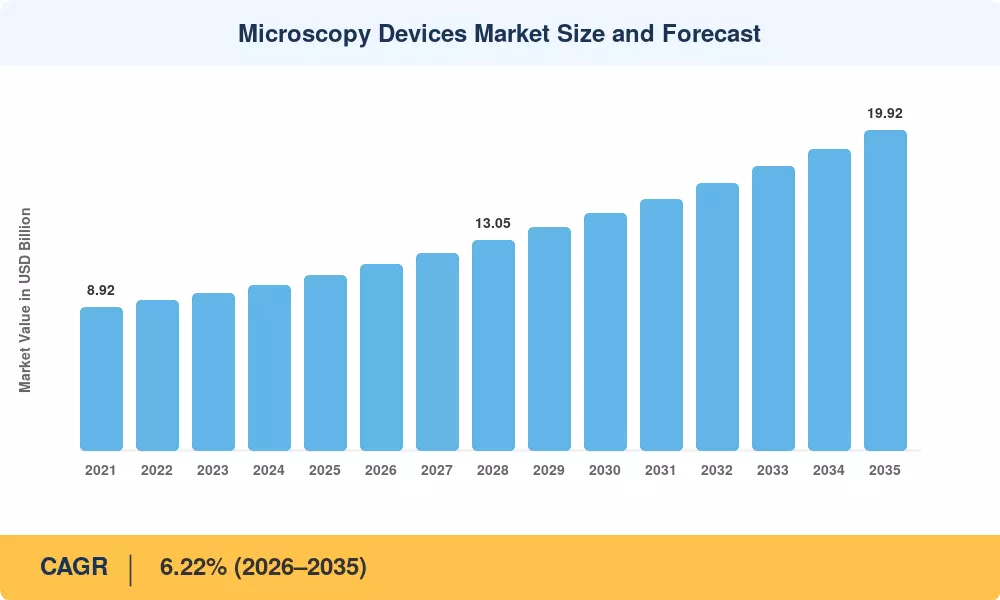
Microscopy Devices Market Size
Microscopy Devices Market to Grow from USD 11.57 Billion in 2026 to USD 19.92 Billion by 2035— Powered by Semiconductor Node Shrinkage, AI-Augmented Pathology
NY, CA, UNITED STATES, July 21, 2026 /EINPresswire.com/ -- As per Market Research Future, the global Microscopy Devices Market size is projected to reach USD 19.92 Billion by 2035 from USD 11.57 Billion in 2026, at a CAGR of 6.22% during the forecast period 2026–2035. The market base was estimated at USD 10.89 Billion in 2025.The 6.22% CAGR—anchored by structural semiconductor and life-science demand rather than discretionary healthcare spending—is driven by three converging forces: semiconductor fabrication roadmaps that require sub-nanometer metrology for gate-all-around transistor architectures, sustained AI-augmented pathology workflow adoption that has pulled legacy manual slide-reading toward machine-learning classifiers capable of cutting pathologist turnaround times by 30–40%, and the technological shift from floor-model cryogenic electron microscopy systems priced beyond USD 5 million toward desktop and compact platforms priced 40–60% below their predecessors, bringing structure-based drug discovery capabilities to mid-tier research institutions.
National governments and multilateral health organizations are amplifying this momentum. The U.S. National Institutes of Health allocated over USD 1.2 billion toward biomedical imaging infrastructure between 2022 and 2024, and the EU Horizon Europe programme committed EUR 950 million to nanoscale research instrumentation through 2027. Samsung, TSMC, and Intel have jointly allocated more than USD 280 billion in fab capital spending through 2028, with a significant portion going into sophisticated inspection and characterization equipment.
Request A Free Sample:
https://www.marketresearchfuture.com/sample_request/2313
Key Market Trends & Growth Drivers
Semiconductor Node Shrinkage and Sub-Nanometer Metrology
Gate-all-around transistor designs at the 2 nm and sub-2 nm nodes necessitate high-resolution metrology capable of photographing features less than 0.5 nm. Samsung, TSMC, and Intel have jointly allocated more than USD 280 billion in fab capital spending through 2028, with a significant portion going into sophisticated inspection and characterization equipment. This expenditure cascade directly benefits the Microscopy Devices Market since each new process node adds to the number of critical-dimension measurement steps in the manufacturing flow. Transmission electron microscopy and sophisticated scanning systems have become non-negotiable line items in fab procurement budgets. Each percentage point of semiconductor node shrinkage translates into measurable instrument volume, and the metrology infrastructure embedded in routine fab operations makes this driver structurally durable through 2035.
The U.S. CHIPS and Science Act allocated USD 52.7 billion for domestic semiconductor manufacturing and research, directly funding advanced metrology infrastructure. South Korea's plans to invest KRW 622 trillion in its semiconductor ecosystem through 2042 will generate sustained demand for high-resolution metrology tools. Pooled procurement through semiconductor consortiums drives per-unit prices down in high-volume tiers, expanding access while compressing manufacturer margins.
AI-Augmented Pathology and Digital Slide Analysis
Since the FDA authorized Paige AI for detecting prostate cancer in 2022, regulatory certifications for AI-assisted slide reading have increased. Hospitals across the United States are implementing whole-slide imaging technologies with machine-learning classifiers to cut pathologist turnaround times by 30–40%. The Microscopy Devices Market benefits from this transition because every AI-pathology deployment necessitates the use of a high-throughput digital scanner, resulting in a hardware refresh cycle that runs parallel to the usual replacement demand curve.
The FDA has cleared more than 180 AI-based medical imaging devices since 2020, with pathology and radiology representing the largest categories. AI systems for detecting prostate cancer in 2022 opened a regulatory pathway that has since expanded to breast, lung, and gastrointestinal malignancies. As per-slide scanning costs fall with scale and cloud-based AI inference becomes standard, the addressable channel widens from high-end reference laboratories to community hospitals and regional pathology networks, extending AI-augmented microscopy beyond traditional settings.
Cryo-EM Democratization and Structural Biology Expansion
Desktop and compact cryogenic electron microscopy systems, priced 40–60% below their floor-model predecessors, are opening structural biology to hundreds of universities and contract research organizations that previously lacked access. The installed base of cryo-EM systems has grown from approximately 400 units worldwide in 2019 to an estimated 900 by 2025. The U.S. NSF invested USD 75 million in shared cryo-EM centres between 2021 and 2024, and the Japan Society for the Promotion of Science funded 12 regional cryo-EM hubs under its Core-to-Core programme. These installations create recurring revenue streams in sample preparation kits, detectors, and software licences that amplify hardware demand across the Microscopy Devices Market.
Thermo Fisher Scientific launched a next-generation 200 kV cryo-TEM platform in October 2024, incorporating an AI-powered particle-selection engine that reduces data-collection time by up to 50%. Further cost reductions are expected to push annual cryo-EM shipments above 200 units by 2030. As per-system costs fall with scale, the addressable channel widens from a handful of national laboratories to mid-tier research institutions, pharmaceutical R&D centers, and contract research organizations, extending cryo-EM capabilities beyond traditional settings.
Ask for Customization:
https://www.marketresearchfuture.com/ask_for_customize/2313
Market Segment Insights
BY PRODUCT TYPE
Optical Microscopy: Dominant segment with ~44.7% revenue share in 2025. Sustained by clinical diagnostics and educational laboratory demand. Systems range from sub-USD 5,000 educational models to USD 800,000 super-resolution platforms, giving optical vendors the broadest addressable buyer population. Clinical diagnostic volumes in histopathology, cytology, and haematology create a replacement-driven demand floor. Carl Zeiss AG and Leica Microsystems anchor this segment.
Electron Microscopy: Fastest-growing product category at 7.02% CAGR (2026–2035). Propelled by dual demand from semiconductor fabs requiring angstrom-level defect inspection and pharmaceutical companies leveraging cryo-EM for structure-based drug design. Thermo Fisher Scientific and JEOL Ltd. lead expansion.
Scanning Probe Microscopy: USD 1.14 Billion in 2025. Nanomaterials characterization and surface analysis sustain demand. Bruker Corporation anchors this segment.
Other Technologies: Growing at 5.85% CAGR. Acoustic, X-ray, and ion-beam imaging niches serve specialized research and industrial applications.
BY APPLICATION
Life Sciences: Dominant application with ~36.5% revenue share in 2025. Spanning drug discovery, histopathology, cell biology, and neuroscience. Pharmaceutical companies routinely deploy confocal, multiphoton, and super-resolution systems in target-identification pipelines, while hospital pathology departments drive the high-throughput slide-scanner segment.
Semiconductor & Electronics: USD 2.72 Billion in 2025. The fastest-growing dollar pool, with each successive sub-3 nm process node requiring additional metrology insertion points that directly expand instrument demand. Samsung, TSMC, and Intel fab spending anchor this segment.
Nanotechnology Research: Fastest-growing application at 7.05% CAGR (2026–2035). Government nano-mission grants and materials-science research drive expansion.
Other Applications: Materials science, geology, and forensics represent incremental demand channels.
BY END USER
Academic & Research Institutes: Dominant end user with ~41.1% share in 2025. Universities and national laboratories concentrate high-value instruments—including cryo-EM, FIB-SEM, and scanning probe systems—in shared core facilities funded through multi-year grants. Government grants and core-facility mandates anchor this segment.
Hospitals, Clinics & Diagnostic Labs: Fastest-growing end-user segment at 7.06% CAGR (2026–2035). Regulatory approvals for whole-slide imaging and AI-assisted diagnostics unlock a conversion cycle from manual to digital microscopy workflows. Digital pathology adoption and point-of-care diagnostics drive expansion.
Pharmaceutical & Biotech Companies: USD 2.38 Billion in 2025. Drug discovery and quality control sustain steady demand for high-resolution imaging platforms.
Industrial & Semiconductor Manufacturers: ~12.4% share in 2025. In-line inspection and failure analysis create sticky recurring demand for electron and scanning probe systems.
Read Detailed Insights:
https://www.marketresearchfuture.com/reports/microscopy-devices-market-2313
Regional Outlook
North America — Dominant Market (~42.0% Share, 2025)
The United States generates approximately 78.5% of North American Microscopy Devices Market revenue, driven by NIH's sustained budget above USD 47 billion annually and the CHIPS and Science Act's allocation of USD 52.7 billion for domestic semiconductor manufacturing and research. Federal R&D grants, pharmaceutical imaging, and fab metrology create a multi-pronged demand base that is structurally insulated from cyclical downturns. Reimbursement breadth and deep capital markets support premium-priced cryo-EM and super-resolution platform demand that emerging-market regions cannot match.
Canada contributes through the National Research Council's network of electron-microscopy facilities serving both academic and industrial clients at 12.3% of regional share. Mexico is growing at 5.85% CAGR on automotive and electronics manufacturing growth, contributing 9.2% of regional share. North America's leadership rests on federal research funding density, semiconductor fab investment, and the structural shift toward AI-augmented and cloud-connected imaging workflows.
Europe — Second Largest (~27.5% Share, 2025)
Europe's Microscopy Devices Market reflects divergent national strategies under a harmonizing regulatory umbrella. Germany anchors regional demand with 28.4% of European share, driven by the density of publicly funded research infrastructure, with over 80 Max Planck Institutes operating advanced imaging cores. The UK contributes USD 1.64 Billion on UKRI life-science funding and the commitment of GBP 25 billion to R&D by 2025 under its Innovation Strategy, directly funding procurement of cryo-EM and super-resolution platforms at Russell Group universities.
France is growing at 5.92% CAGR on CNRS materials science programmes. Italy holds 10.8% of regional share on pharmaceutical and biotech cluster expansion. Spain is growing at 5.74% CAGR on EU cohesion fund laboratory upgrades. The Nordic countries contribute 8.2% of regional share on clean-energy materials R&D. Harmonization pressure from the EU Medical Device Regulation (MDR)—which has delayed or withdrawn an estimated 25–30% of microscopy SKUs from the European market due to constrained notified-body capacity—is gradually narrowing national differences, lifting baseline demand across the region. Russia is growing at 4.85% CAGR on domestic instrument substitution initiatives. The rest of Europe contributes 11.5% of regional revenue on varied academic and industrial demand.
Asia-Pacific — Fastest-Growing Region (7.21% CAGR, 2026–2035)
Asia-Pacific is the engine of the Microscopy Devices Market. China holds the largest regional share at 35.2%, with the National Natural Science Foundation and semiconductor self-sufficiency initiatives directing state-backed capital toward domestic manufacturers. The biopharma sector attracted USD 18.5 billion in venture funding between 2022 and 2024, with new CDMO facilities equipped with advanced imaging from day one.
India is growing at 7.65% CAGR on the DST Nano Mission and AIIMS imaging upgrades. The National Education Policy 2020 targets a doubling of gross enrolment in STEM disciplines by 2035, requiring modern microscopy facilities at hundreds of new and upgraded campuses. Japan contributes USD 1.32 Billion on JEOL/Hitachi domestic ecosystem and advanced materials leadership. South Korea is growing at 7.48% CAGR on Samsung and SK Hynix fab expansion. ASEAN economies contribute 8.4% of regional share on clinical diagnostics modernization. The rest of Asia-Pacific is growing at 6.35% CAGR on university laboratory build-outs. The region's combined contribution anchors the global volume base for semiconductor metrology, structural biology, and materials-science imaging demand.
Middle East & Africa — Emerging Opportunity (USD 0.44 Billion, 2025)
The Middle East & Africa carries the widest analytical infrastructure gap and therefore significant opportunity. Saudi Arabia leads the region with 28.5% share, with Vision 2030 catalysing over USD 6 billion in higher-education research infrastructure investment, benefiting greenfield laboratory builds at institutions including KAUST and King Abdulaziz University. The UAE holds 22.3% of regional share on Khalifa University and MBZUAI labs, with Dubai Science Park hosting over 40 accredited testing laboratories.
South Africa is growing at 5.95% CAGR on the Council for Scientific and Industrial Research operating the region's largest electron-microscopy facility, supporting both mining-sector quality control and biomedical research. Egypt is growing at 5.68% CAGR on medical diagnostics infrastructure expansion. The rest of MEA contributes 26.7% of regional revenue on varied clinical and extractive-industry demand. Capital cost barriers remain a restraint—a fully configured transmission electron microscope can cost between USD 2 million and USD 7 million, limiting adoption in price-sensitive countries to shared national facilities rather than departmental installations. Service contracts that cost 8–12% of the system price per year add to the budgetary burden. Leasing models and shared-core facility networks are unlocking incremental access.
Competitive Landscape and Recent Developments
The Microscopy Devices Market exhibits moderate concentration, with an estimated Herfindahl-Hirschman Index in the 1,200–1,500 range and the top five vendors accounting for an estimated 55–62% of global revenue. Concentration is highest in high-income segments where detector integration breadth, consumable ecosystem lock-in, and post-sale service networks create steep barriers; the emerging-market tier is more fragmented as regional distributors compete on price. Competitive differentiation increasingly hinges on integrated software ecosystems and service-contract economics rather than raw optical or electron-beam performance alone.
The competitive landscape is stratified between full-spectrum platform leaders serving semiconductor and life-science markets, cryo-EM specialists capturing structural biology growth, and scanning probe innovators consolidating the nanomaterials characterization segment.
KEY COMPANIES AND RECENT MILESTONES
Carl Zeiss AG (2024–2025): Maintains leadership with electron, light, and X-ray microscopy and correlative workflows, commanding ~12–16% of global Microscopy Devices Market revenue. Full-spectrum portfolio with strong semiconductor metrology footprint.
Thermo Fisher Scientific (October 2024): Launched a next-generation 200 kV cryo-TEM platform incorporating an AI-powered particle-selection engine that reduces data-collection time by up to 50%. In January 2026, announced a USD 450 million expansion of its electron microscopy manufacturing facility in Brno, Czech Republic, adding 200,000 square feet of cleanroom space to double production capacity for cryo-TEM systems by 2028. Dominates cryo-EM installed base with integrated life-science workflows. Estimated revenue share: ~11–15%.
Leica Microsystems (Danaher) (2024–2025): Confocal, stereo, surgical, and super-resolution microscopy anchor a high recurring-revenue model with pathology-automation focus. Service and consumable revenue represent 45–50% of total segment revenue. Estimated revenue share: ~8–11%.
Future Outlook: 2026–2035
By 2030, AI-integrated autonomous microscopy will become the operating system of imaging device delivery. Machine-learning algorithms are transitioning from post-acquisition image analysis to real-time instrument control, enabling self-driving microscopes that autonomously adjust focus, stage position, and detector parameters.
By 2030, an estimated 35% of newly shipped electron and scanning probe systems will embed on-instrument AI inference chips, reducing operator dependency and boosting throughput. Real-time AI control creates a data asset that manufacturers can monetize through subscription-based software updates and predictive maintenance contracts, creating a new business model layered on top of the core hardware franchise.
More Related Research Insights:
https://www.marketresearchfuture.com/reports/onchocerciasis-market-38965
https://www.marketresearchfuture.com/reports/ophthalmology-device-market-43094
https://www.marketresearchfuture.com/reports/orthopedic-digit-implant-market-42219
https://www.marketresearchfuture.com/reports/orthopedic-support-system-market-31926
https://www.marketresearchfuture.com/reports/oscillating-positive-expiratory-pressure-device-market-43674
https://www.marketresearchfuture.com/reports/oseltamivir-market-43200
https://www.marketresearchfuture.com/reports/osmolarity-testing-device-market-38845
https://www.marketresearchfuture.com/reports/osteoarthritis-treatment-market-43259
https://www.marketresearchfuture.com/reports/outpatient-rehabilitation-center-market-43237
https://www.marketresearchfuture.com/reports/oxycodone-drugs-market-43683
Larry Wilson
WantStats Research And Media Pvt. Ltd.
+1 855-661-4441
email us here
Visit us on social media:
LinkedIn
Facebook
YouTube
X
Legal Disclaimer:
EIN Presswire provides this news content "as is" without warranty of any kind. We do not accept any responsibility or liability for the accuracy, content, images, videos, licenses, completeness, legality, or reliability of the information contained in this article. If you have any complaints or copyright issues related to this article, kindly contact the author above.
